Temple or Shrine? How to Tell the Difference in Kyoto
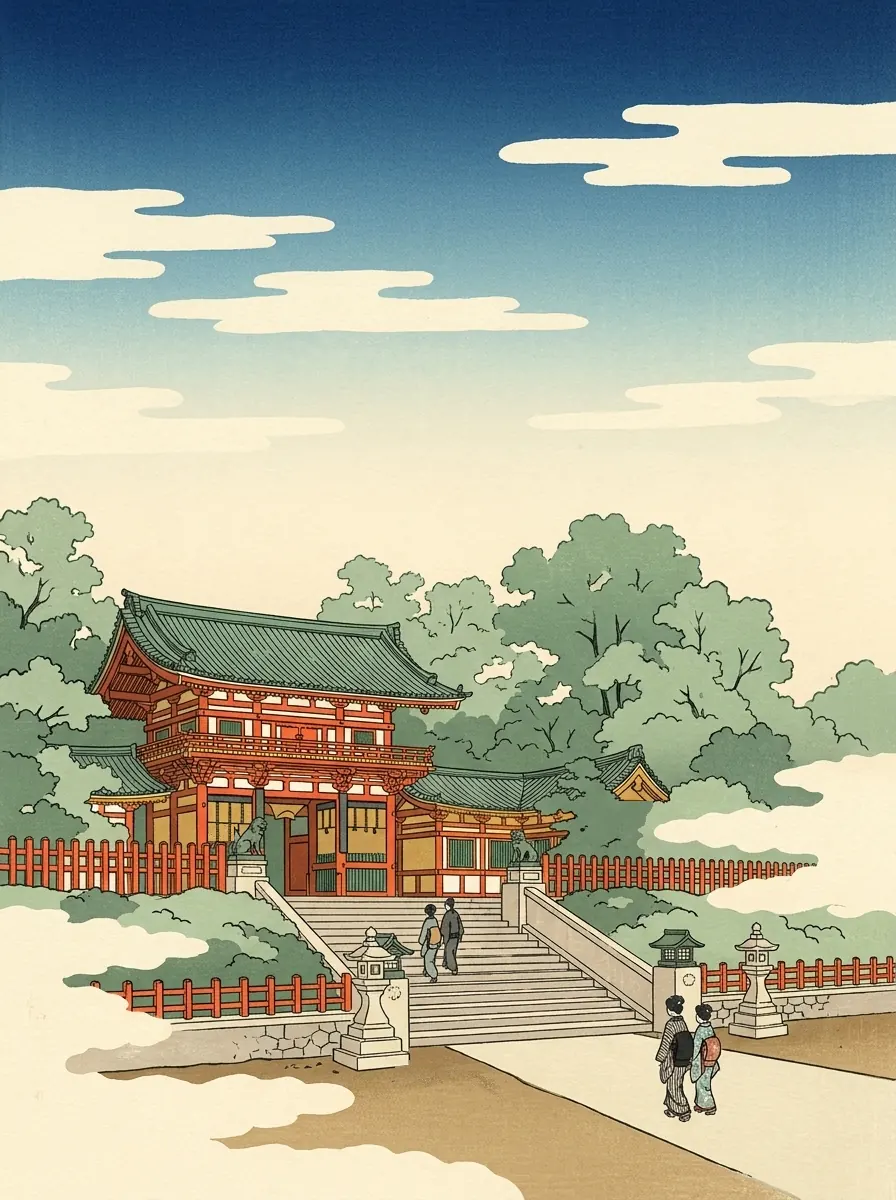
From Gion, Shijō street runs east and then uphill, and at the top it meets a vermilion gate two storeys high. People walk off the street and straight through it. The gate belongs to a shrine, Yasaka-jinja, and its name is younger than you'd guess: until 1868 this was the Gion Shrine. The year 1868 explains a good part of what follows.
Here's the short answer. Shrines serve Shinto and mark their entrance with a torii; temples serve Buddhism and have a sanmon gate. At a shrine people clap before they pray, and at a temple they don't. That's the rule of thumb the Japan National Tourism Organization (JNTO) gives, and in Kyoto it gets you most of the way. Below are three clues you can use from the first morning of a trip, then the places where they blur.
Kyoto's numbers: about 1,700 temples and 800 shrines
Kyoto has about 1,700 Buddhist temples and about 800 Shinto shrines, according to the Kyoto City Tourism Association's Kyoto Traveler's Promise. Seventeen of the city's sites are listed together by UNESCO as World Heritage, under the name Historic Monuments of Ancient Kyoto.
Across Japan, Kokugakuin University's Encyclopedia of Shinto puts the number of shrines at about 80,000, and National Geographic, in an article from 20 December 2023, counted roughly 77,000 temples. With that many of both, a quick way to tell them apart earns its place on day one.
Clue 1: the gate
The gate is the quickest tell. Every shrine has a torii, the JNTO guide says, even a shrine with no main sanctuary. Temples have a sanmon, a main gate.
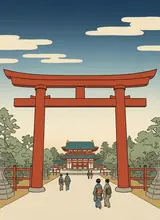
On the shrine side, the avenue to Heian-jingū passes under a torii about 24 metres tall. At Shimogamo-jinja, you walk under a torii into the forest called Tadasu no Mori. And the red tunnel at Fushimi Inari Taisha is made of torii, every one of them donated, with the giver's name and a date painted on the back. Its guide tells you the best moment to read them.
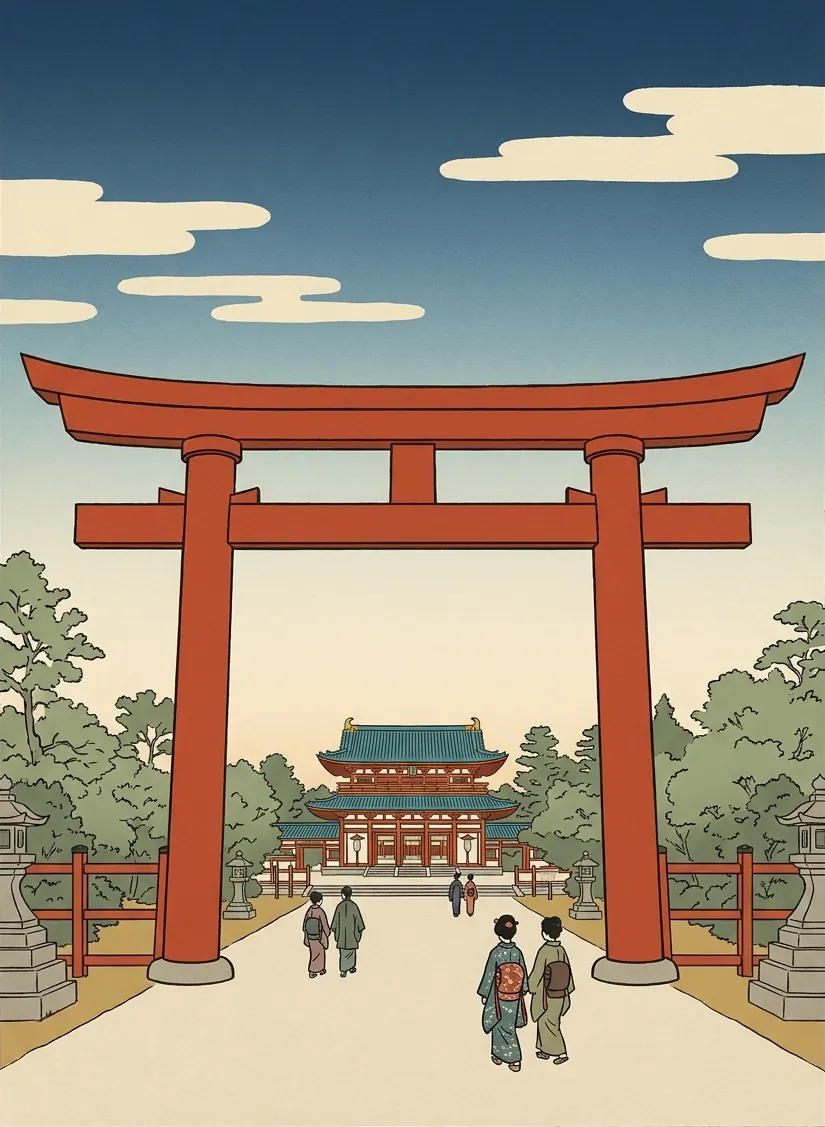
Heian-jingū: a torii on the approach, the first clue that you're at a shrine.
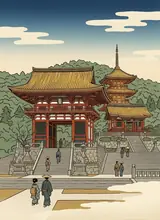
On the temple side, the Sanmon at Nanzen-ji rises some 22 metres on the way in. The one at Tōfuku-ji, completed in 1425, is the oldest surviving main gate of any Zen temple in Japan. Chion-in keeps its own detail in the writing: most temples write the name of their gate with the character for mountain, and Chion-in uses the character for three. The reason is in its guide.
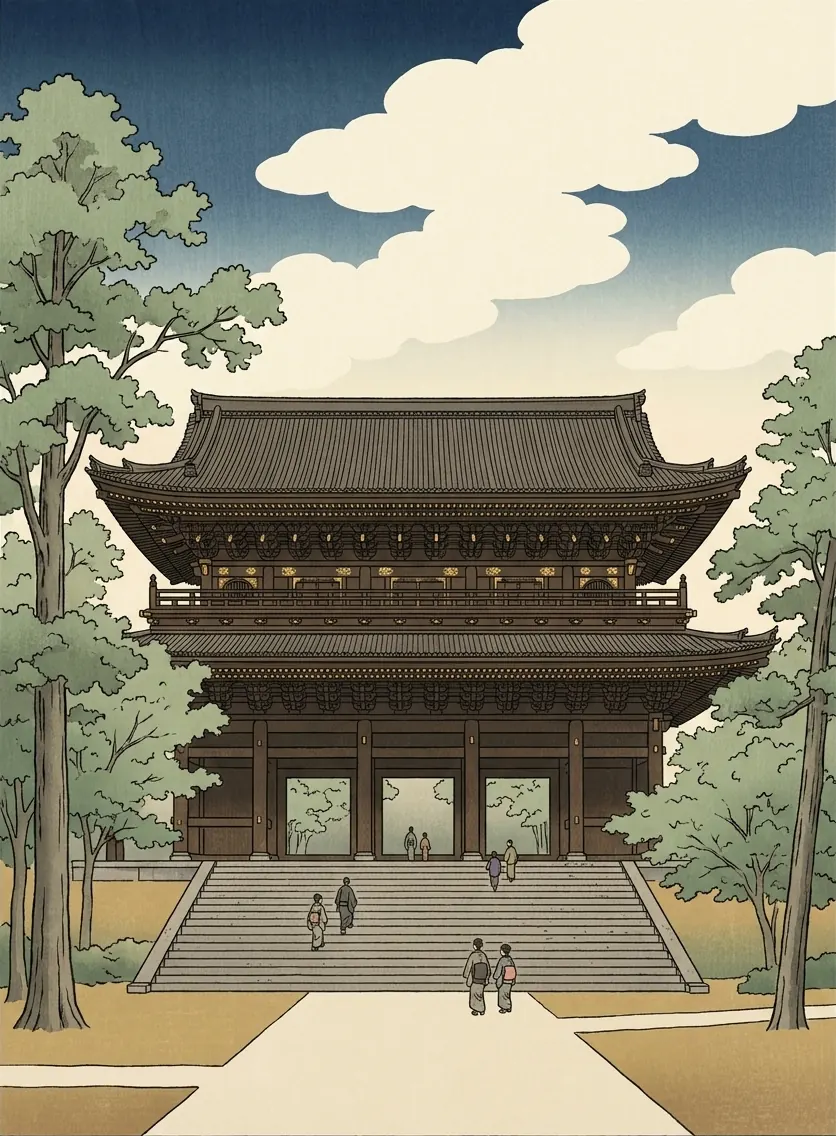
Chion-in: the Sanmon, about 24 metres high and one of the largest wooden gates still standing in Japan. A sanmon is the clue that you're at a temple.
Clue 2: the name
The end of a name is the second clue, a shortcut National Geographic set out in its 2023 article. Shrines often end in -jinja or -gū. Temples often end in -ji, -tera or -in, and in our own guides every name ending in -dera is a temple too.
Most of the sites in our guides follow the pattern. Yasaka-jinja, Shimogamo-jinja and Kamigamo Jinja are shrines, and so are Heian-jingū and Kitano Tenmangū. Nanzen-ji and Tōfuku-ji are temples, like Kiyomizu-dera, Kurama-dera and Chion-in.
The shortcut has gaps, even in a short list. Eikan-dō and Sanjūsangen-dō both end in -dō, and both are temples. Fushimi Inari Taisha ends in Taisha, and it's a shrine. When an ending is new to you, go back to the gate.
Clue 3: what people do
The third clue is in people's hands. At a shrine, the routine the JNTO describes is two bows, two claps, a prayer, then one last bow. At a temple, people don't clap. Many temples have incense, and where a temple has a temizuya, visitors purify there just as they would at a shrine.
In front of the main hall at Yasaka-jinja, worshippers clap twice. There's a story attached to that sound, and it's in the guide. At Sanjūsangen-dō, a temple, the clue is in the air and at the door: there's incense in the hall, and visitors walk it with their shoes off.
Why the line blurs in Kyoto
"Shrines for Shinto, temples for Buddhism" is a useful shorthand, and it's a simplification. For centuries the two were mixed. Until the Meiji period, shrines and temples were often a single combined institution, as the scholar Sakamoto Koremaru explains in the Encyclopedia of Shinto's entry on shinbutsu bunri. In 1868 the government ordered them separated, and Buddhist elements were removed from shrines.
Yasaka-jinja carries that date in its name. It was the Gion Shrine until 1868, and it was renamed that year, the year the government separated the two traditions. So the gate at the top of Shijō street leads into a shrine whose present name is exactly as old as the separation.
The mixing still shows. Shrines and temples often stand side by side, National Geographic noted in 2023. And a torii can stand at a temple: in Osaka, outside the West Gate of the temple Shitennō-ji, there's a stone torii put up in 1294, now an Important Cultural Property, according to the Japan Tourism Agency. So treat the three clues as clues. When the gate, the name and the clap agree, you know where you are. When they don't, you've usually found a place with a longer story, and those are the ones worth the extra minute.
Visiting both
Most of the courtesy is shared. From the JNTO guide and Kyoto's Traveler's Promise:
- Bow once before the gate, and walk a little to one side of the centre, under a torii too.
- At a shrine: two bows, two claps, a prayer, one bow.
- At a temple: skip the clap. Many temples have incense.
- Where a temple has a temizuya, purify there as you would at a shrine.
- Keep your voice low.
- Take your shoes off on tatami, and carry a shoe bag.
- Photography may be banned in places, so watch for the signs.
The shrines and a selection of temples in Sacred Kyoto
Shrines
- Fushimi Inari Taisha
- Yasaka-jinja
- Heian-jingū
- Shimogamo-jinja
- Kamigamo Jinja
- Kitano Tenmangū
Temples
- Kinkaku-ji
- Kiyomizu-dera
- Nanzen-ji
- Tōfuku-ji
- Chion-in
- Sanjūsangen-dō
Each temple and shrine in these lists has its own guide in Sacred Kyoto: the story behind what you're looking at, to read or to listen to.
Questions
What's the difference between a temple and a shrine in Japan?
A shrine serves Shinto and has a torii at its entrance; a temple serves Buddhism and has a sanmon gate, according to the Japan National Tourism Organization. At a shrine people bow twice, clap twice, pray and bow once, and at a temple they don't clap. The line is softer than it sounds. Until 1868, shrines and temples were often one institution (Kokugakuin University, Encyclopedia of Shinto).
Do you clap at a temple?
No. The Japan National Tourism Organization's guide says you don't clap at a temple. The claps belong to the shrine routine: two bows, two claps, a prayer, one bow.
Can a temple have a torii?
Yes. Shitennō-ji, a temple in Osaka, has a stone torii outside its West Gate, put up in 1294 and now an Important Cultural Property (Japan Tourism Agency). Until 1868, shrines and temples were often a single institution, and that year the government ordered them separated (Kokugakuin University, Encyclopedia of Shinto).