Temples Near Fushimi Inari: Where to Go Next
In Sacred Kyoto, three temples share Fushimi Inari's corner of the city, the area the app calls South & Fushimi: Tōfuku-ji, Tō-ji and Daigo-ji. Tōfuku-ji is one stop away, on the JR Nara Line. Tō-ji is a walk from Kyoto Station, the stop after that. Daigo-ji is out on the Tōzai Line at Daigo Station, a trip of its own. Each has one thing worth stopping for.
Fushimi Inari Taisha is a shrine, and this page starts there, with one thing to know before you leave. Then come the three temples, each with its detail to find, and a dated list on getting there.
Before you leave Fushimi Inari
Fushimi Inari Taisha
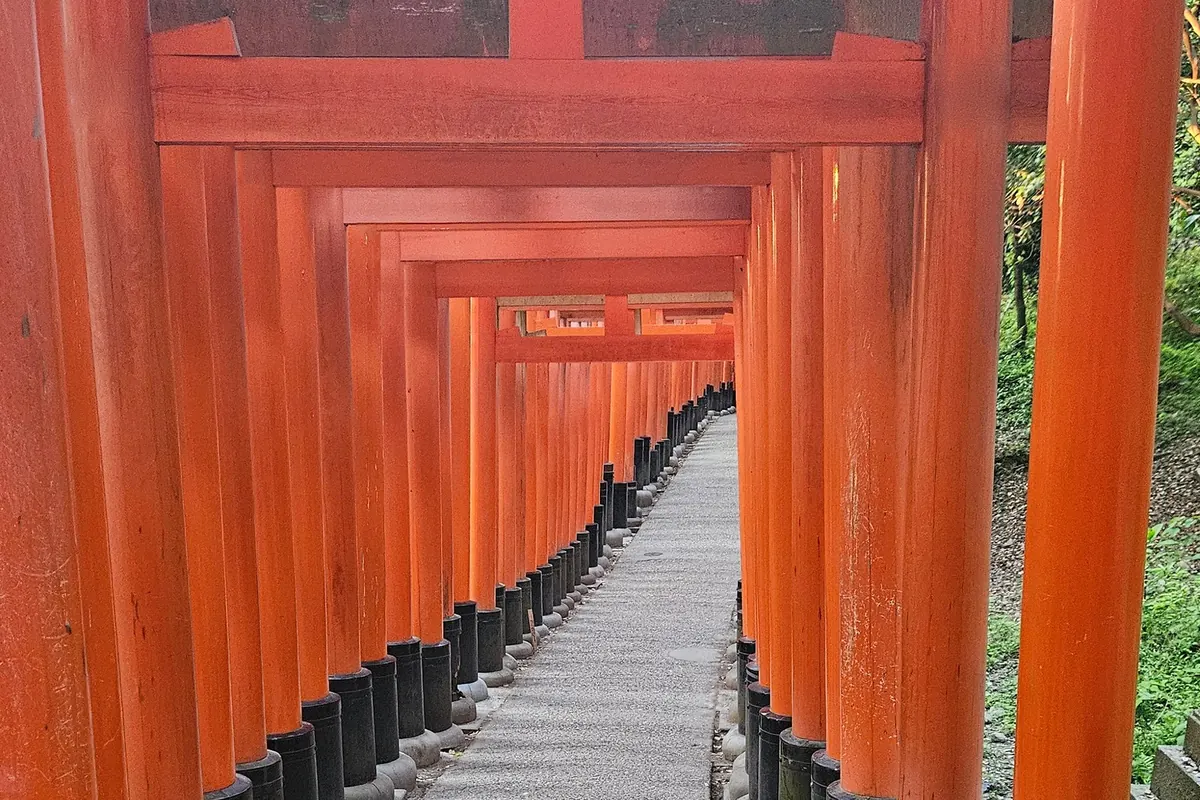
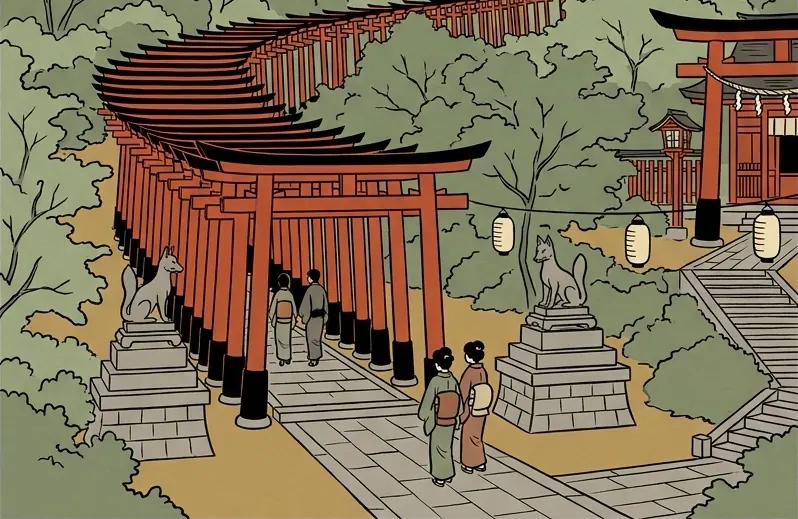
Since the Edo period, visitors and companies have given torii to the shrine, in hope that a prayer will be heard or in thanks once it has been. The shrine counts around 10,000 on the mountain, and the donors' names and dates are written on the back of the gates. So the tunnel you've just walked through is made of gifts, one gate after another.
Before you set off for the temples, look for those names. Fushimi Inari Taisha's guide ends right there, on one small thing to do with a single name, so read it on the train or listen to it in the tunnel.
The Rōmon, the main gate at the foot of the mountain, dates from 1589 and was given by Toyotomi Hideyoshi.
Fushimi Inari Taisha is a Shinto shrine. The three places below are Buddhist temples, and each has its own guide in Sacred Kyoto.
Tōfuku-ji: the meditation hall
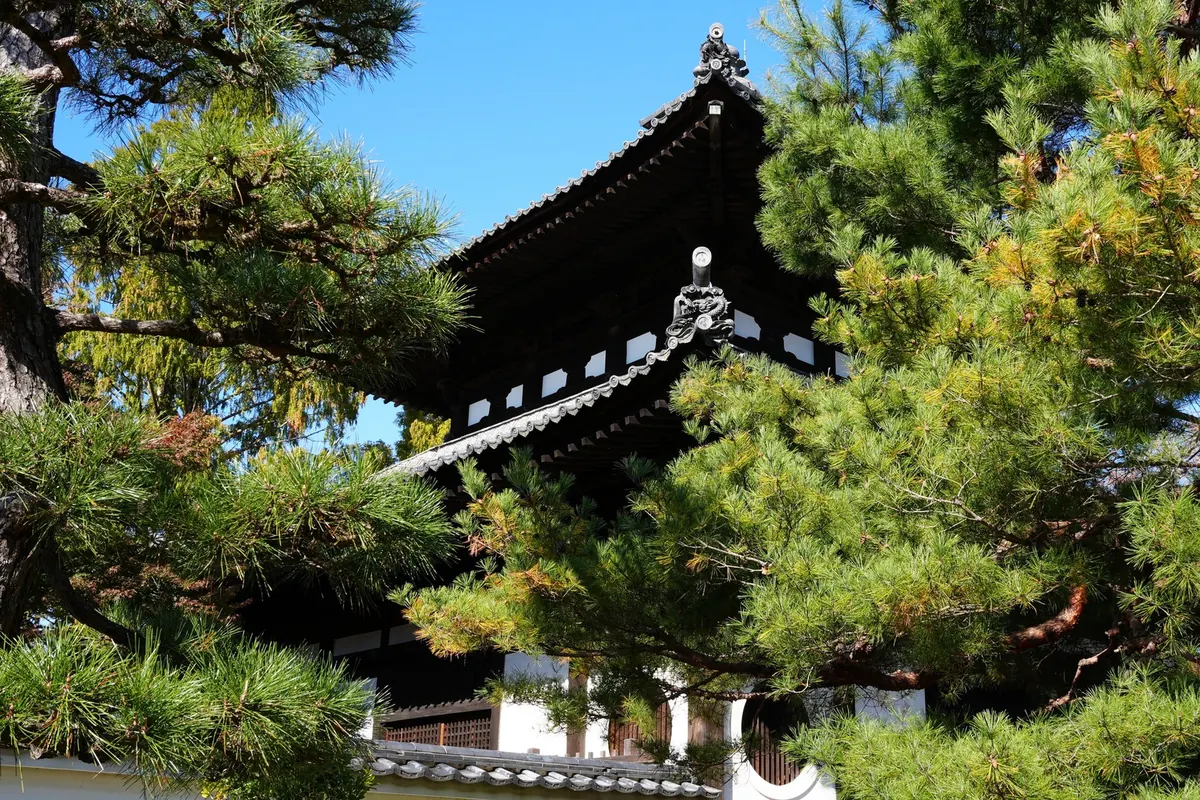
Tōfuku-ji
On a local JR train back toward Kyoto Station, get off one stop early, at Tōfukuji.
Tōfuku-ji (東福寺) is a Zen temple. Building began in 1236, and the regent Kujō Michiie named it with one character from each of two temples in Nara, Tōdai-ji and Kōfuku-ji.
The thing to find here is the meditation hall, the Zendō. It was rebuilt in 1347, and the temple calls it the oldest and largest in Japan, the only Zen meditation hall left from the medieval period. Find a place where the whole hall fits in your view, and give it a few minutes. It has stood in these grounds for more than six and a half centuries.
For a visit in autumn, Tōfuku-ji in Autumn covers the temple's season. The rest of Tōfuku-ji is in its guide, the meditation hall included, to read on the train or to listen to in the grounds.
Tō-ji: the temple that remains
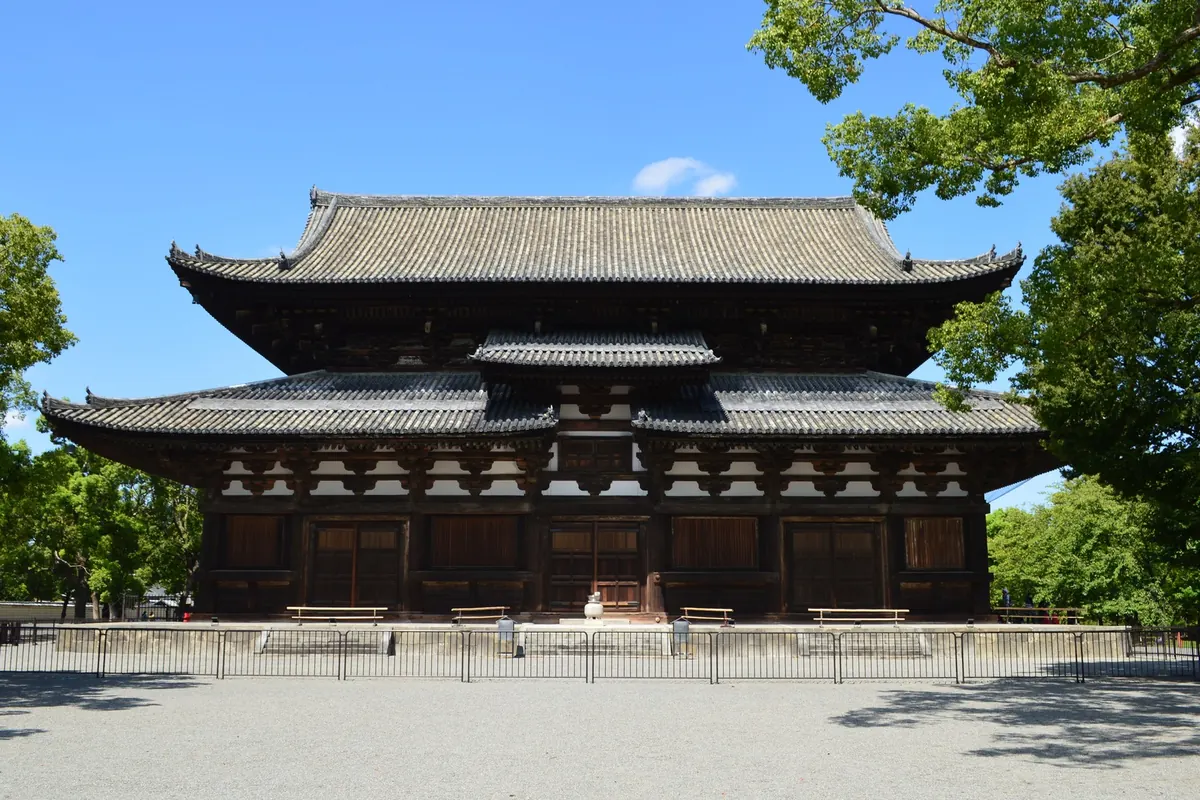
Tō-ji
Tō-ji (東寺) is an esoteric Buddhist temple, and the first thing to find there is a story about where it stands.
When the capital, Heian-kyō, was founded in 794, only two temples were allowed inside it: Tō-ji and Sai-ji, one on each side of the Rajōmon, the capital's south gate. Sai-ji and the gate are gone. By the temple's own record, Tō-ji alone remains from Heian-kyō. So the ground you walk in on is one of the only two temple sites the capital allowed, and it's the one that lasted.
The second thing to find is in the lecture hall, the Kōdō. There, 21 statues stand together on one platform as a mandala in three dimensions, an arrangement credited by tradition to Kūkai, also known as Kōbō Daishi. Fifteen of them date from the 9th century, and Kyoto Prefecture calls them the oldest surviving group of Esoteric Buddhist sculpture in Japan. Take in the whole platform first, as one arrangement, and then let your eyes rest on a single figure.
Tō-ji's five-storey pagoda, about 55 metres high and the tallest traditional wooden building in Japan, has its own entry in 10 Temples to Visit in Kyoto, and What to Find at Each.
Tō-ji's guide tells the rest, from the capital's first years to Kūkai, to read before you go or to listen to in the grounds.
Daigo-ji: the pagoda from 951
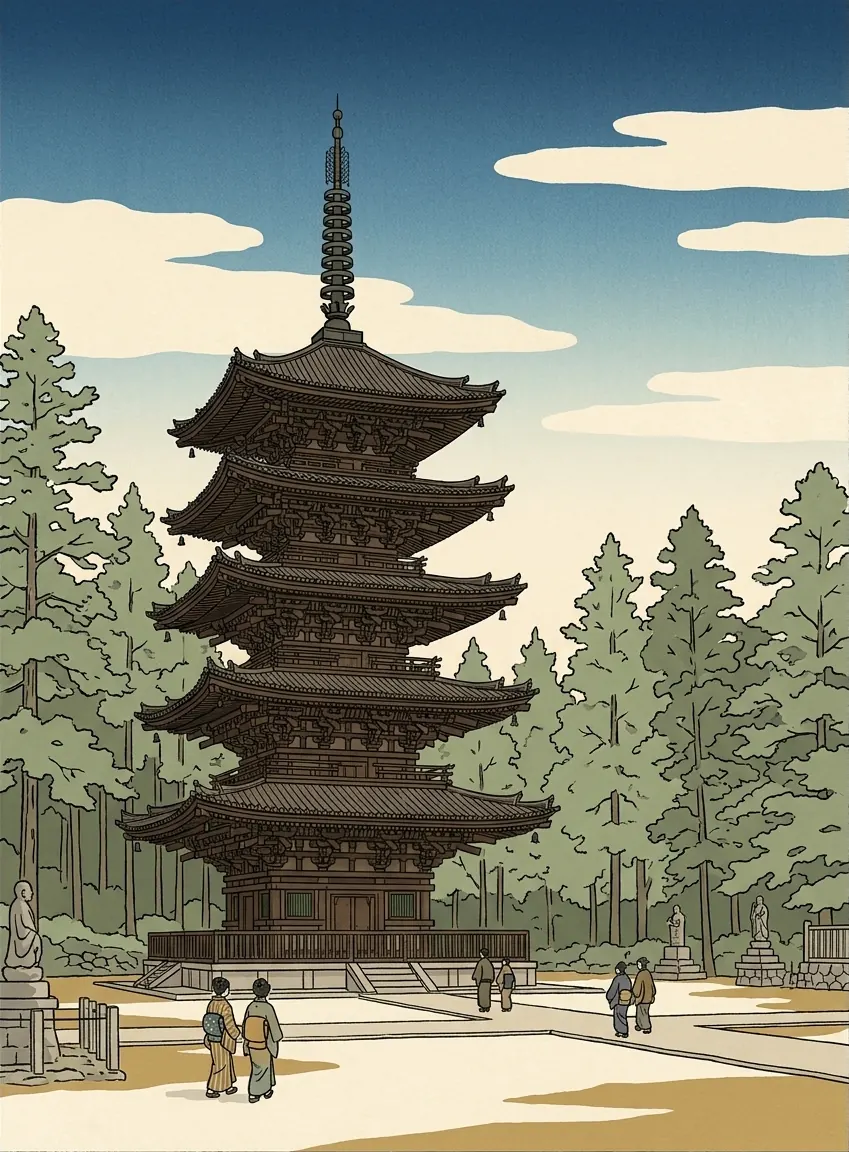
Daigo-ji
Kyoto's oldest wooden building, the temple says, stands in Fushimi Ward too, at Daigo-ji.
Daigo-ji (醍醐寺) is an esoteric temple, and that building is its five-storey pagoda, finished in 951 and now a National Treasure. The temple's history says that in its lower precinct, the pagoda alone came through the fires and wars.
Then look up to the top. The spire that crowns the pagoda, the sōrin, stands about 13 metres, and the whole pagoda about 38, so the spire takes up a third of its height. Stand far enough back to see the five roofs and the spire at once, and the proportion is plain to see.
One more date belongs to Daigo-ji's history. In 1598, Toyotomi Hideyoshi, who gave Fushimi Inari its Rōmon gate, had 700 cherry trees planted at Daigo-ji for a blossom party.
Daigo-ji is reached from Daigo Station on the Tōzai Line, so give it a trip of its own. Daigo-ji's guide tells the rest, from the pagoda's builders to Hideyoshi's party, to read on the way or to listen to beside the pagoda.
How to plan it
Tōfuku-ji fits into the same half day as Fushimi Inari, one stop along the same JR line. Tō-ji and Daigo-ji each make a trip of their own. Choose by the detail you most want to see: a meditation hall from 1347, one of the only two temples the capital allowed, or a pagoda finished in 951.
Getting there
As of 29 October 2026, each line below follows the official page linked in it. Stations and walking times can change, so open the pages again before you go.
- Fushimi Inari Taisha: JR Inari Station, two stops and about 5 minutes from Kyoto Station on the Nara Line, is right next to the shrine. From Fushimi-Inari Station on the Keihan Main Line, it's a 5-minute walk east (the shrine's access page).
- Tōfuku-ji from Fushimi Inari: JR Inari Station and Tōfukuji Station are neighbours on the Nara Line, one stop apart, and local trains stop at both (JR West's station list, in Japanese). By Keihan, Tōfukuji is two stops from Fushimi-Inari (Keihan's station list, in Japanese).
- Tōfuku-ji from Kyoto Station: the JR Nara Line takes about 3 minutes to Tōfukuji Station, then it's about 10 minutes on foot. City bus 88 or 208 takes about 15 minutes to the Tōfukuji stop, then it's about 4 minutes on foot (Tōfuku-ji's access page, in Japanese).
- Tō-ji: it's about 15 minutes on foot from the Hachijō exit of Kyoto Station, or 10 minutes from Kintetsu Tōji Station (Tō-ji's location page).
- Daigo-ji: it's about 10 minutes on foot from exit 2 of Daigo Station on the Tōzai Line. Keihan Bus's Kyoto Daigoji Line also runs from Kyoto Station, about 30 minutes to the "Daigoji" stop (Daigo-ji's access page, in Japanese).
Questions
What temples are near Fushimi Inari?
Tōfuku-ji, Tō-ji and Daigo-ji share Fushimi Inari's area in Sacred Kyoto, South & Fushimi. Tōfuku-ji is one stop from Inari Station on the JR Nara Line, Tō-ji is a walk from Kyoto Station, and Daigo-ji is a separate trip, on the Tōzai Line at Daigo Station. Each has one thing to find: a meditation hall rebuilt in 1347, one of the only two temples allowed inside the capital founded in 794, and a five-storey pagoda finished in 951.
How do you get from Fushimi Inari to Tōfuku-ji?
As of 29 October 2026, JR Inari Station and Tōfukuji Station are neighbours on the JR Nara Line, one stop apart, and local trains stop at both. From Tōfukuji Station, the temple's access page gives about 10 minutes on foot. By Keihan, Tōfukuji is two stops from Fushimi-Inari Station.
What should I look for at Fushimi Inari?
Look for the names. Since the Edo period, visitors and companies have given torii to Fushimi Inari Taisha in hope or in thanks for a prayer heard, and the donors' names and dates are written on the back of the gates. At the foot of the mountain, find the Rōmon, the main gate, given by Toyotomi Hideyoshi in 1589.