What Is a Torii? The Gates of Kyoto's Shrines, Explained
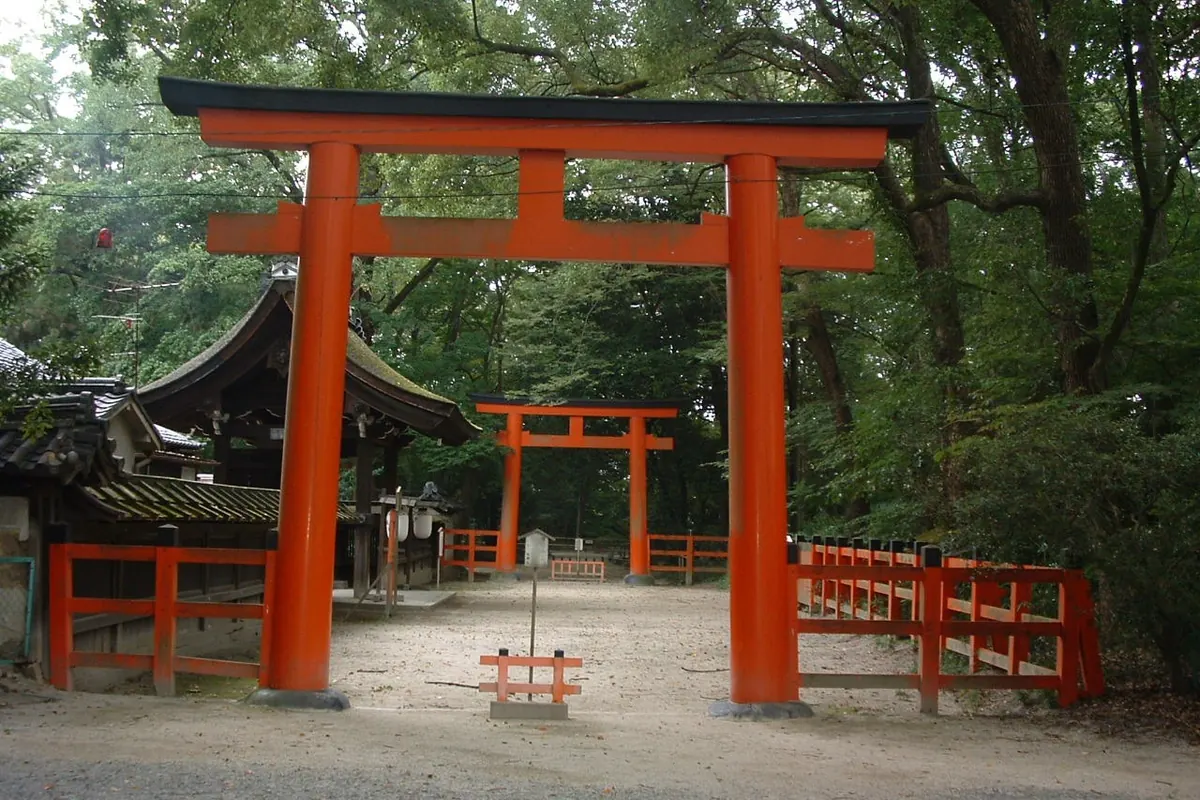
A torii is the gateway that marks the way into a Shinto shrine, and every shrine has one, the Japan National Tourism Organization says. It's two pillars carrying a top beam, tied together by a crossbeam. Learn its parts and its two shapes, and you can read a Kyoto shrine before you're through the gate.
This page shows you how to read a torii, why Fushimi Inari has so many, and how to walk through one. Then it takes you to five torii to find in Kyoto, at Fushimi Inari Taisha, Heian-jingū, Shimogamo-jinja, Kamigamo Jinja and Kitano Tenmangū, each a shrine with its own guide in Sacred Kyoto.
How to read a torii
Where the word torii comes from is still debated, and one theory reads it as "bird perch". The torii itself is easier to read, part by part.
The parts of a torii, and its two shapes
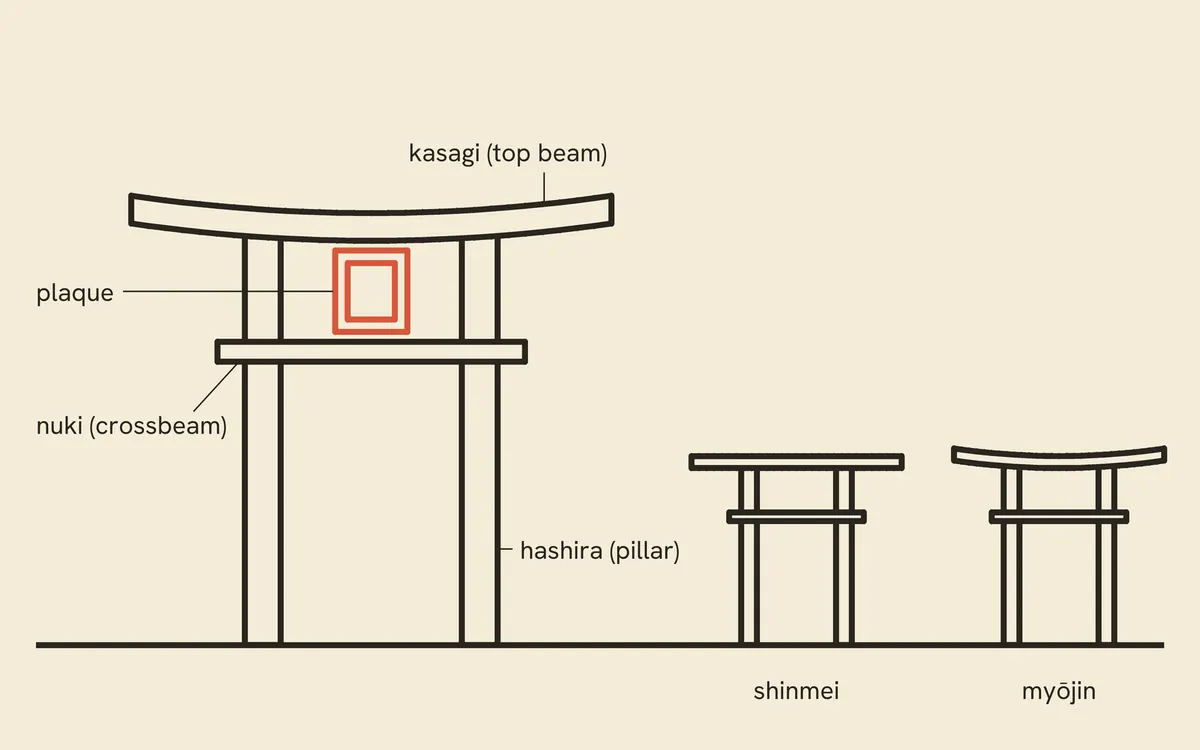
The parts. A torii stands on two pillars, the hashira. They carry the top beam, the kasagi, which runs out past them on either side, and below it a crossbeam, the nuki, ties the two pillars together. Many torii also have a plaque at the centre, usually with the shrine's name. So where there's a plaque, it usually names the shrine you're about to enter.
The two shapes. Look at the top beam. Torii are usually sorted into two families: on a shinmei torii the beams run straight, and on a myōjin torii the top beam curves up at the ends. Most of the torii you'll meet are myōjin, and Inari torii belong to that line. So one look at the top beam usually tells you which family you're under.
Wood, stone, vermilion. Wood and stone are the most common materials, the Encyclopedia of Shinto says, and metal, concrete and even plastic are used too. In Kyoto, Kitano Tenmangū's great torii is granite. Where a torii is vermilion, the reasons given vary, and Fushimi Inari Taisha gives its own: the shrine says vermilion is a charm against evil and a colour of rich harvests.
First torii, second torii. On a long approach, a shrine can have several torii, and they're numbered from the outside in: the first torii, ichi no torii, then the second, ni no torii. Kamigamo Jinja's own map names its first and second torii this way. The number tells you how far in you've come.
The names. At Fushimi Inari Taisha, read the gates themselves as well. The donors' names and dates are written on the back of the gates.
Why Fushimi Inari has so many
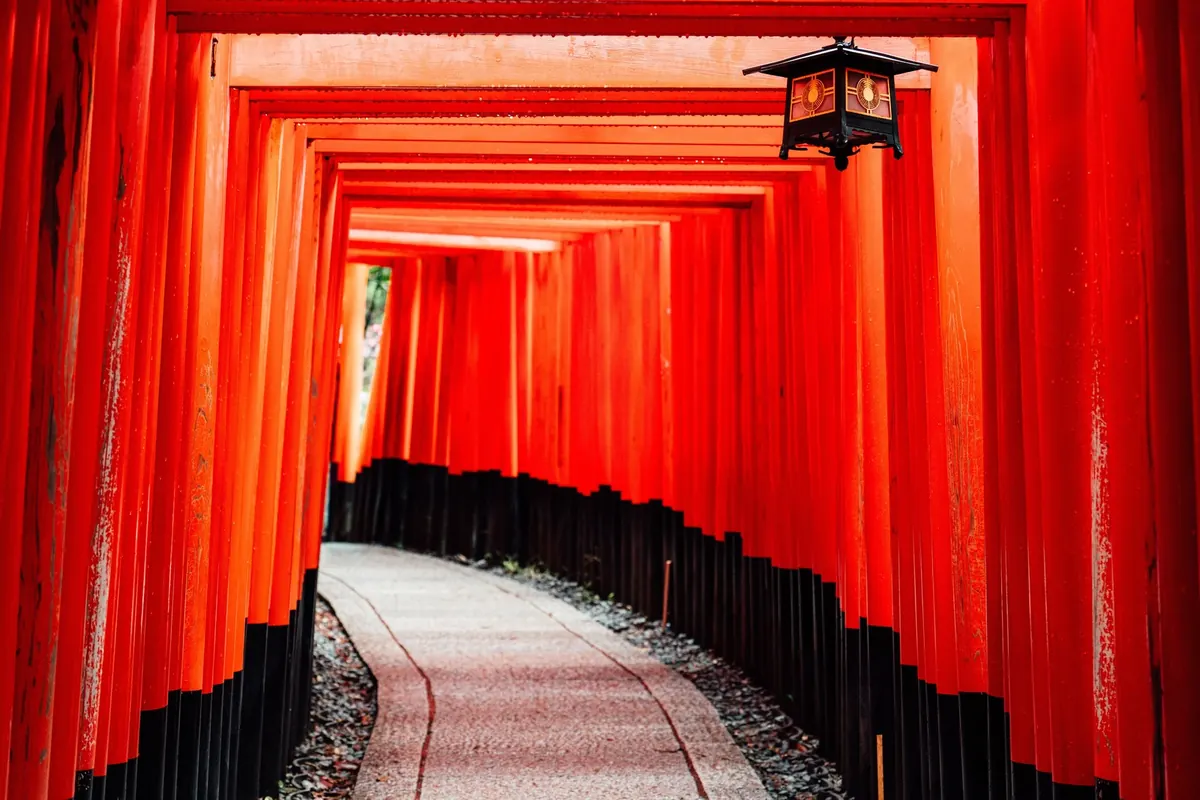
At Fushimi Inari Taisha, giving a torii is a custom that goes back to the Edo period. Visitors and companies give one in hope that a prayer will be heard, or in thanks once it has been, the shrine explains. It counts around 10,000 torii of all sizes along the mountain paths, and the donors' names and dates are written on the back of the gates.
So the gates along those paths are gifts, one after another. Fushimi Inari Taisha's guide ends among them, on one small thing to do with a single name, ready to read before you go or to listen to on the mountain.
How to walk through
Walk through a torii a little to one side. The Japan National Tourism Organization's advice is to bow once before the gate, then pass a little to one side of the centre. The Kyoto City Tourism Association gives the reason: the centre of a torii is the deities' path, so visitors walk along either side. On a long approach, that holds for every torii you pass under, from the first to the last.
Temple or Shrine? has the rest of the courtesy at a shrine, from the bows to the claps.
Five torii to find in Kyoto
Each of these shrines has its own guide in Sacred Kyoto, and each has a torii worth a few minutes of your time.
Fushimi Inari Taisha: the rows
Fushimi Inari Taisha
Here the torii stand in rows, so close together that they make a tunnel up the mountain. They were given in hope or in thanks for a prayer heard, and the donors' names and dates are written on the back of the gates. Walk slowly through the vermilion, and look closely at the gates you pass under. The rest of the shrine's story, from the mountain to the gates, is in Fushimi Inari Taisha's guide, to read on the way or to listen to in the tunnel.
Heian-jingū: the avenue beneath
A torii on the approach
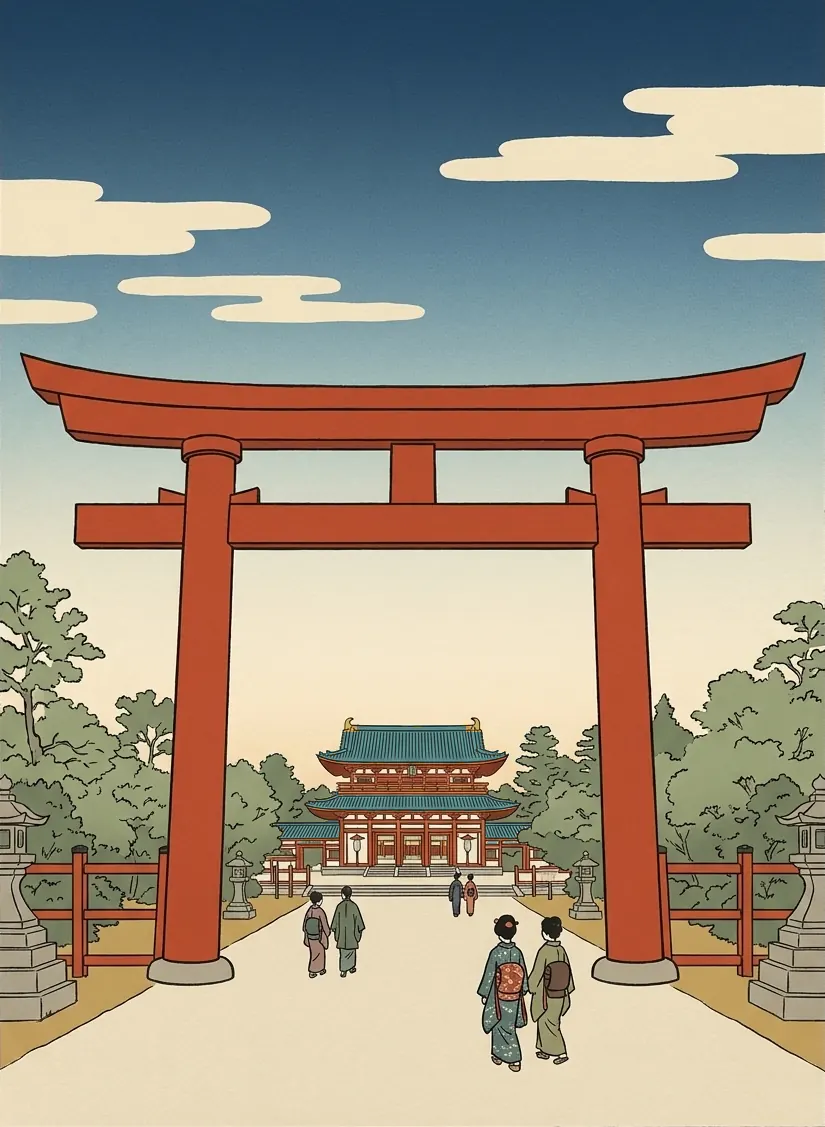
Heian-jingū's great torii stands about 24 metres tall, and the whole avenue to the shrine passes beneath it. See it from a distance first, so its size reads against the road and the people on it. Then walk under it, a little to one side, and look up at the beams. Heian-jingū's guide has the rest, ready to read before you go or to hear on the approach.
Shimogamo-jinja: into the forest
At Shimogamo-jinja, the way in is under a torii, and the forest beyond it is called Tadasu no Mori. Walk through that torii and keep going, and the approach carries you on into the trees. Shimogamo-jinja's guide tells the rest, to read before you go or to listen to in the shade of the forest.
Kamigamo Jinja: past the second torii
Kamigamo Jinja
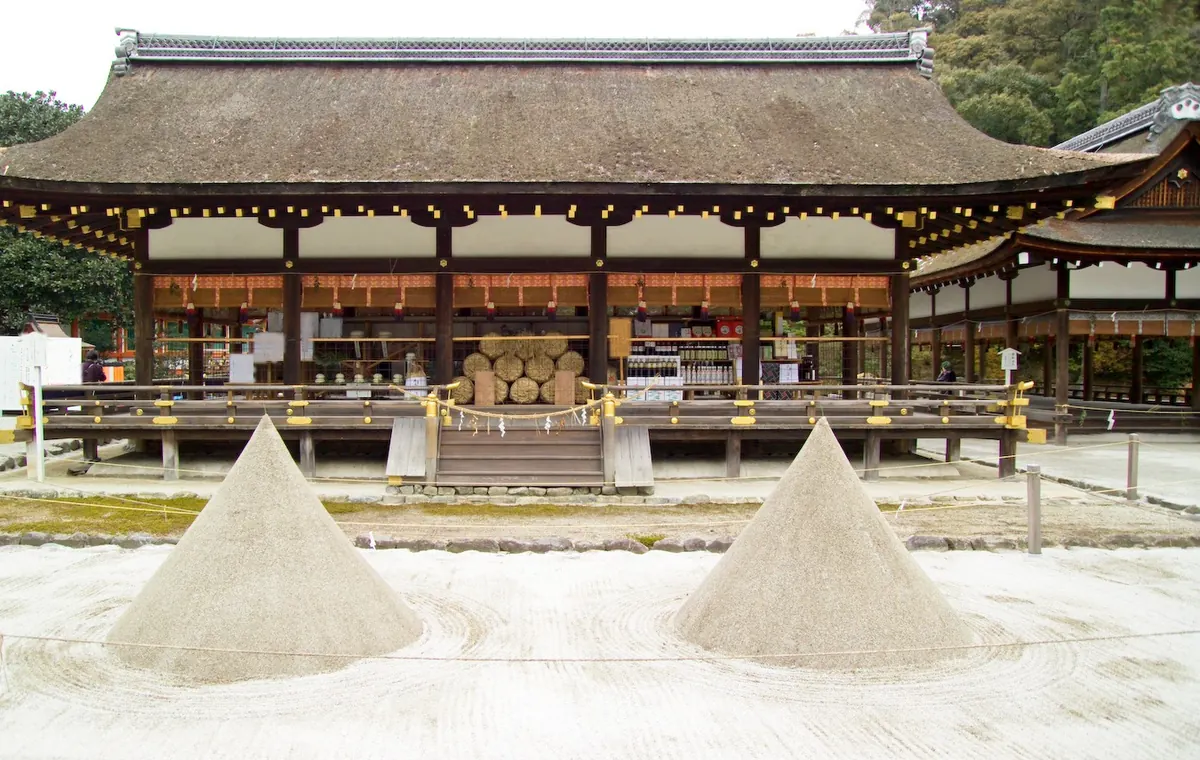
Count your way in at Kamigamo Jinja, where the shrine's own map names a first torii and a second. Past the second torii, the ground opens out, and straight ahead stand two cones of sand called tatesuna, in front of the Hosodono hall. They're the thing to find. Why they're there is in Kamigamo Jinja's guide, to read before you go or to listen to in front of the cones.
Kitano Tenmangū: a stone torii
Kitano Tenmangū's first torii, facing Imadegawa-dōri, is a granite gate about 11.4 metres tall, and Kyoto City's Kamigyo Ward calls it a shinmei torii. So here you can read two things at once, the stone and the family. Look up for its plaque too, which reads 天満宮, Tenmangū. Kitano Tenmangū's guide tells the rest of the shrine's story, to read on the way or to listen to once you're through the gate.
A torii at a temple
A torii can stand at a temple too. In Osaka, outside the West Gate of the temple Shitennō-ji, a stone torii was put up in 1294 by order of the emperor, and it's now an Important Cultural Property, according to the Japan Tourism Agency. Until 1868, shrines and temples were often one institution, and Temple or Shrine? tells that story, along with how to tell the two apart.
Questions
What is a torii?
A torii is the gateway that marks the entrance to a Shinto shrine, and every shrine has one, according to the Japan National Tourism Organization. It's two pillars carrying a top beam, tied together by a crossbeam, and many torii have a plaque at the centre, usually with the shrine's name.
Why does Fushimi Inari have so many torii?
Since the Edo period, visitors and companies have given torii to Fushimi Inari Taisha in hope that a prayer will be heard, or in thanks once it has been, the shrine explains. It counts around 10,000 torii of all sizes along the mountain paths. The donors' names and dates are written on the back of the gates.
Should you walk through the middle of a torii?
Walk through a little to one side. The Kyoto City Tourism Association says the centre of a torii is the deities' path, so visitors walk along either side. The Japan National Tourism Organization also advises one bow before the gate.